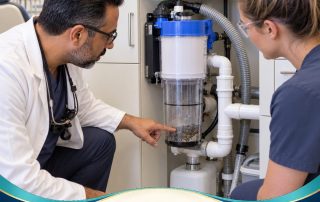
ADA Professional Product Review-Executive Summary: An Evaluation of Amalgam Separators
An ADA review of nine amalgam separators found all met the 95% ISO bar—but maximum fill volume and bypass design shape real-world mercury capture.


An ADA review of nine amalgam separators found all met the 95% ISO bar—but maximum fill volume and bypass design shape real-world mercury capture.
A practical guide to removing mercury fillings more safely—steps that protect patients and the dental team and align with the SMART approach.
Patients and dental students showed higher urine mercury after early contact with amalgam fillings—why careful handling and safer removal matter.
The mean blood concentration of mercury was 6.3 μg/l (SD=1.31 range 4.15–8.93). BML was positively associated with age, years in practice, working hours per day, number of amalgam restorations per day, number of amalgam removal per week, sea food consumption, working years in present office, using amalgam powder, using diamond bur for amalgam removal, dry sterilization of amalgam contaminated instruments, and deficient air ventilation.
Amalgam waste storage is done in a leak-proof, plastic container filled with water until disposed according to manufacturer instructions (Nixon and Rowbotham 1971, Mantyla and Wright 1976, Johnson 1978). Habitual amalgamator checks for cracks and mercury leakage is crucial (Langworth et al. 1997, Brown and Sherriff 2002).
This study evaluated the ability of a chairside filtration system to remove particulate-based mercury (Hg) from dental-unit wastewater. Prototypes of the chairside filtration system were designed and fabricated using reusable filter chambers with disposable filter elements. The system was installed in five dental operatories utilizing filter elements with nominal pore sizes of 50μm, 15μm, 1μm, 0.5μm, or with no system installed (control).
This study aimed to investigate a possible connection between removal of dental amalgam restorations supported by antioxidant therapy and indicative changes of clinical chemistry parameters. A group of 24 patients, referred for complaints related to amalgam restorations, underwent a removal of their amalgams. All patients were treated with antioxidants (vitamin B-complex, vitamin C, vitamin E, and sodium selenite).
Fatigue, memory trouble, and low mood can sometimes track with mercury exposure. This report walks through how those symptoms may show up—and why safer amalgam care still matters.
Abolishing the use of dental amalgam and cleaning the tubing systems is the most efficient long-term solution to reduce Hg emissions from dental clinics. Until then, Hg emissions originating from placing, polishing or removing existing amalgam fillings, should be counteracted by the use of low-emission amalgam separators, already on the market or presently being developed for use alone or together with sedimentary type amalgam separators.
This laboratory evaluation shows that amalgam separators and the filtration devices removed at least 97.05 percent of the amalgam in samples with particle-size distribution as specified in ISO Standard 11143.