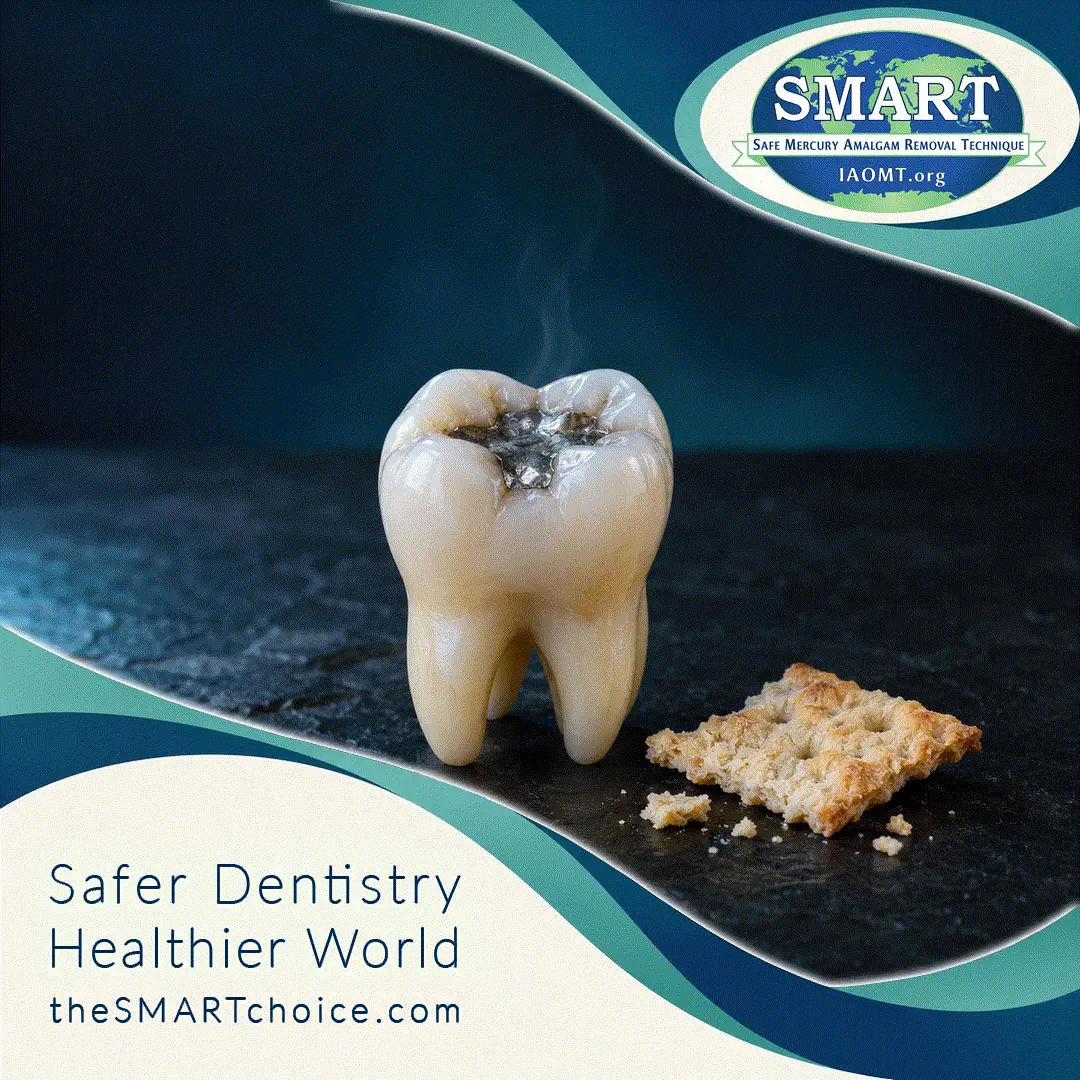
Dental amalgam—“silver” fillings—are roughly half mercury by weight. That mercury does not stay locked forever inside the restoration. It leaves the filling as mercury vapour: odourless, colourless, tasteless, and toxic when inhaled.
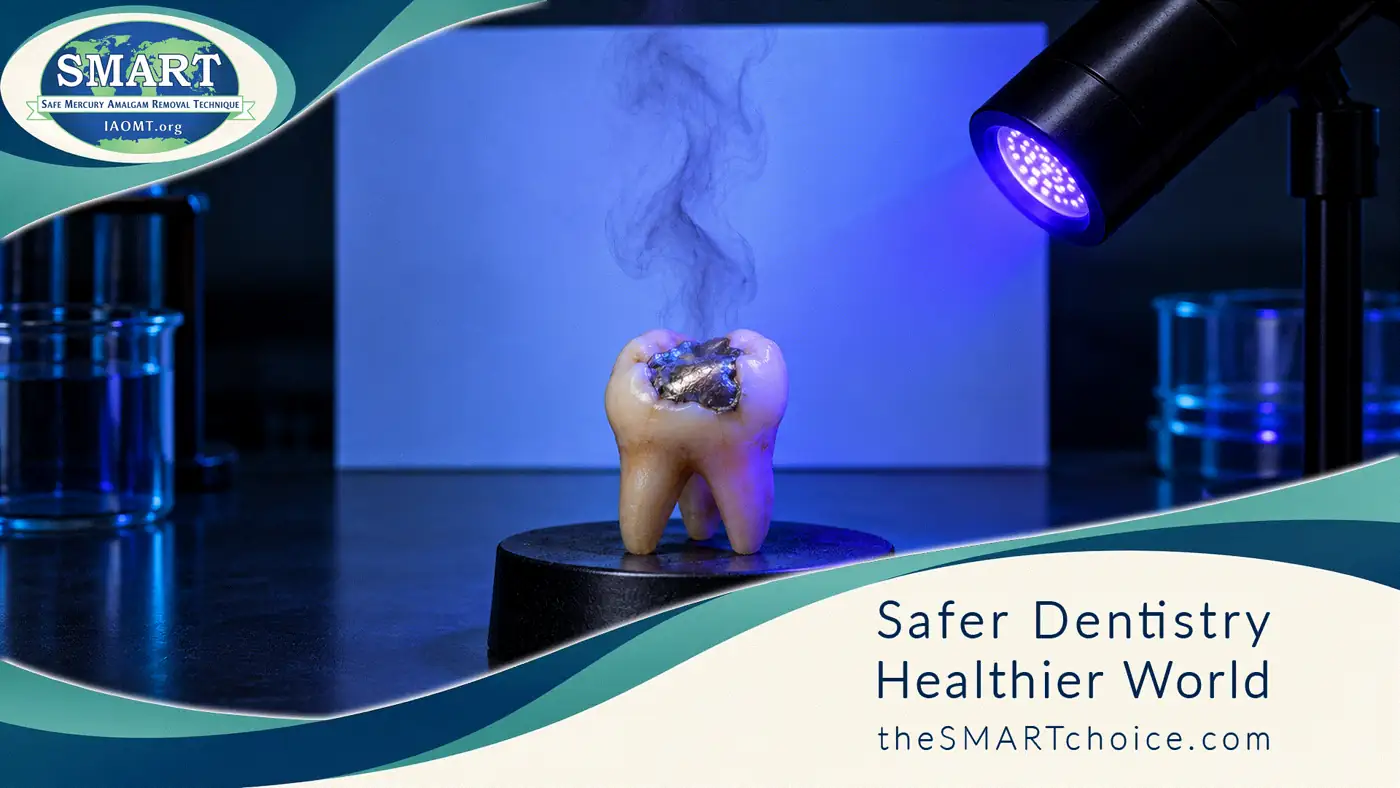
Smoking Teeth = Poison Gas, produced by David Kennedy, DDS, for the International Academy of Oral Medicine and Toxicology (IAOMT), makes that invisible vapour visible. Under ultraviolet light, mercury vapour pouring off an amalgam filling appears as a dark plume—poison gas you can finally see. That is why this film is Reference #3 in the IAOMT Safe Mercury Amalgam Removal Technique (SMART) materials: it shows, in plain sight, that amalgam outgases mercury.
The film that made amalgam vapour impossible to ignore
The short version most people know was uploaded to YouTube on January 30, 2007 (about 8 minutes 31 seconds). IAOMT also distributes a longer DVD edition—about 40 minutes—with expert interviews and a demonstration of safer amalgam removal. The core teaching point is the same in both: see with your own eyes how mercury vapour escapes from dental amalgam.
On the SMART protocol page, Reference #3 sits with the other citations that establish two foundational facts:
- Dental amalgam restorations contain about 50% mercury.
- Those fillings emit mercury vapour—and release rises when the surface is stimulated.
WHO’s 2005 Mercury in Health Care policy paper places typical amalgam mercury content near 45–55%. Calling the restoration a “silver filling” does not change the chemistry. Mercury is the dominant toxic metal in the mix, and elemental mercury vaporizes at mouth temperature.
What the demonstration shows
The core sequence uses an extracted tooth with a longstanding amalgam filling (often described in the narration as about 25 years old). Mercury vapour is invisible in ordinary light. In the demonstration, a phosphorescent / ultraviolet (“black light”) setup—a miner’s-lamp style light near mercury’s absorption wavelength of about 253.7 nm—turns escaping vapour into a shadow or “smoke” against a bright background.
Narrated versions of the short clip show vapour release under everyday and clinical stimulations of the filling surface:
- contact with water near body temperature;
- brief mechanical rubbing (for example, with a pencil eraser—likened in the narration to polishing or hygienist cleaning);
- heating (narration often cites roughly 110°F / hot coffee–range conditions);
- drilling / cutting of amalgam—the dental-office scenario that matters most for patient and staff exposure.
The plume is not a special-effects trick. It is mercury vapour leaving amalgam, made visible by a wavelength of light that mercury absorbs.
It really is mercury—not water vapour
Critics have claimed the visible plume is only water vapour. That claim collapses under the physics of the demo.
IAOMT authors, including Kennedy, apply a miner’s-lamp / atomic-absorption principle: elemental mercury vapour absorbs ultraviolet light near 253.7 nm and casts a shadow. Water vapour absorbs very little light at that wavelength and does not produce the same effect. IAOMT’s public response materials (“Quackbusters Wrong Again on Amalgam”) make that chemistry argument explicit.
A companion one-minute film, It Really Is Mercury! (uploaded May 2007), goes further: after cooling and then gently stimulating an amalgam surface, a Jerome mercury vapour analyzer registers rising mercury in air. The clip’s description cites the U.S. EPA inhalation reference value of 0.3 µg/m³ for elemental mercury—the same figure listed in EPA’s Integrated Risk Information System (IRIS) as the elemental mercury inhalation Reference Concentration (RfC) of 3 × 10⁻⁴ mg/m³ (0.3 µg/m³).
Instrument readings in a teaching film are still mercury readings. They corroborate what the UV demo already shows: amalgam releases mercury vapour, and stimulation increases that release.
What the narration drives home
Across widely available descriptions and transcript excerpts of the short film, the narration is unambiguous:
- Amalgam fillings leak mercury continuously, with increases after stimulation.
- Once vapour is visible under the light setup, levels are described as more than 1,000 times higher than an EPA air allowance.
- Stimulated leakage can continue for about 1½ hours at a minimum.
- Amalgam has been a major human source of mercury-vapour exposure—consistent with WHO-era framing of dental amalgam’s role in mercury exposure.
- Precaution, informed consent, and occupational protection are non-negotiable when mercury is present in the mouth and the operatory.
Those points are why the film still circulates in mercury-free dentistry: it refuses the industry habit of treating an invisible toxin as if it were not there.
Why stimulation and removal demand protection
Everyday mechanical and thermal stimulation—chewing, brushing, grinding, polishing, and especially high-speed drilling—are exactly the conditions under which amalgam vapour release increases. If a 25-year-old filling “smokes” mercury under UV light after gentle rubbing or warming, cutting that filling with a high-speed handpiece without rigorous vapour and particulate control is reckless.
That is the practical bridge to SMART:
- Mercury vapour is real — and the Smoking Teeth demo makes an invisible hazard tangible for patients and staff.
- Stimulation increases release — which is why protocols emphasize water coolant, high-volume evacuation, isolation, filtration, and respiratory protection when amalgam is cut or removed.
- Pregnancy and breastfeeding require extra caution — IAOMT’s patient-facing SMART materials advise against elective amalgam removal for pregnant or breastfeeding patients; protect the vulnerable rather than expose them.
- Safer removal is teachable — the longer DVD’s safe-removal segment and the SMART protocol itself exist because uncontrolled drilling aerosolizes mercury vapour and amalgam particulate into the breathing zone.
Reference #3 is not a soft “awareness” ornament. It is visual proof that amalgam outgases mercury—especially when disturbed—and it anchors why SMART’s engineering and PPE recommendations exist.
Practical takeaways
- “Silver” fillings are mercury fillings. Typical dental amalgam is about half mercury by weight (WHO ~45–55%; IAOMT ≈50%).
- Amalgam emits mercury vapour. The Smoking Teeth demonstration makes that vapour visible under UV light near ~253.7 nm.
- The plume is mercury, not steam. Mercury absorbs at that wavelength; water vapour does not cast the same shadow. The Jerome analyzer companion film confirms mercury in air after stimulation.
- Stimulation matters. Body-temperature water, rubbing, heat, and drilling all increase release in the demo—matching why chewing, polishing, and removal are high-exposure moments.
- Removal without protection is unsafe. SMART exists to reduce patient and staff exposure to mercury vapour and particulate when amalgam is removed.
- Watch the film. Short cut: https://www.youtube.com/watch?v=9ylnQ-T7oiA — then ask any clinic cutting amalgam what vapour controls they actually use.
Bottom line
Smoking Teeth = Poison Gas (Kennedy / IAOMT; short version uploaded January 30, 2007) endures because it does what industry messaging will not: it shows mercury vapour leaving dental amalgam. A so-called silver filling is roughly half mercury. That mercury vaporizes. Stimulation—especially drilling—increases the release. The vapour is odourless and invisible in ordinary light, which is exactly why dentistry was able to downplay it for decades. Under the right ultraviolet setup, the poison gas is unmistakable.
For patients and dentists evaluating SMART and mercury-free care, the takeaway is simple and firm: amalgam releases mercury vapour—especially when stimulated—and that vapour matters. Protect people when those fillings are placed, worn, and removed.
Citations
- Kennedy D. Smoking Teeth = Poison Gas [online video]. Champion’s Gate, FL: IAOMT; uploaded January 30, 2007. YouTube (David Kennedy, DDS channel), approx. 8:31.
- https://www.youtube.com/watch?v=9ylnQ-T7oiA
- (IAOMT SMART Reference #3; access date in SMART materials: March 14, 2019.)
- International Academy of Oral Medicine and Toxicology (IAOMT). Product page: Smoking Teeth = Poison Gas (DVD / educational video; UV “black light” shadow visualization, expanded interviews, and safe amalgam removal demonstration).
- https://iaomt.org/product/smoking-teeth-poison-gas/
- International Academy of Oral Medicine and Toxicology (IAOMT). The Safe Mercury Amalgam Removal Technique (SMART) (protocol recommendations and numbered references; Ref. 3 = Smoking Teeth video; amalgam ≈50% mercury and vapour emission discussed with refs 1 and 2–16).
- https://iaomt.org/resources/safe-removal-amalgam-fillings/
- Kennedy D. It Really Is Mercury! [online video]. YouTube; uploaded May 16, 2007 (approx. 1:04). Companion demonstration using a Jerome mercury vapour analyzer.
- https://www.youtube.com/watch?v=4qvNf4NVZvI
- IAOMT. “Quackbusters Wrong Again on Amalgam” (miner’s-lamp / AAS principle at ~253.7 nm; water vapour does not cast the same shadow).
- https://iaomt.org/quackbusters-wrong-amalgam-2/
- U.S. EPA IRIS. Mercury, elemental (CASRN 7439-97-6) — inhalation Reference Concentration (RfC) 3 × 10⁻⁴ mg/m³ (0.3 µg/m³).
- https://cfpub.epa.gov/ncea/iris2/chemicalLanding.cfm?substance_nmbr=370
- Summary PDF: https://iris.epa.gov/static/pdfs/0370_summary.pdf
- World Health Organization. Mercury in Health Care: Policy Paper. Geneva; 2005 (WHO/SDE/WSH/05.08). Typical amalgam mercury content ~45–55%.
- https://www.who.int/docs/default-source/wash-documents/mercury-in-health-care.pdf
- IAOMT. Let the Truth Be Told video series product notes (Smoking Teeth segment: elemental mercury vapour from a 25-year-old amalgam; safer removal framing).
- https://iaomt.org/product/let-the-truth-be-told-video-series/