
Vandeven JA, McGinnis SL. An assessment of mercury in the form of amalgam in dental wastewater in the United States. Water, Air, and Soil Pollution. 2005 Jun;164(1-4):349-366.
How much dental mercury actually reaches U.S. sewers, treatment plants, and surface waters? Environ International analysts, in an ADA-funded assessment, traced amalgam mercury from the operatory through publicly owned treatment works (POTWs) and sewage-sludge incinerators—numbers that later informed national dental effluent policy discussions.
What the study found
Using ADA practice surveys, USGS commodity data, municipal studies, and published trap/filter efficiencies, the authors estimated:
- ~35.2 tons (31.9 metric tons) of mercury used annually as amalgam in the U.S.
- ~29.7 tons (26.9 metric tons) discharged to internal dental wastewater during placements and removals.
- After conventional chair-side traps and vacuum filters (~78% industry-wide capture), ~6.5 tons (5.9 metric tons) still reach POTWs—roughly half of estimated total mercury load to those plants.
- After ~95% POTW capture, surface-water inputs via POTW effluent plus sludge-incinerator deposition totaled about 0.4 tons per year.
- Nationwide separator cost-effectiveness was estimated at roughly $380 million to $1.14 billion per ton of mercury reduction under their scenarios.
The mass balance assumed mercury largely remains amalgamated through conveyance—supported by cited release studieswhile acknowledging land-applied biosolids and landfills as out-of-scope pathways.
[Full text available via ADA-hosted PDF of the Springer article; figures above match the published abstract and body mass-balance sections.]
Why it matters for SMART
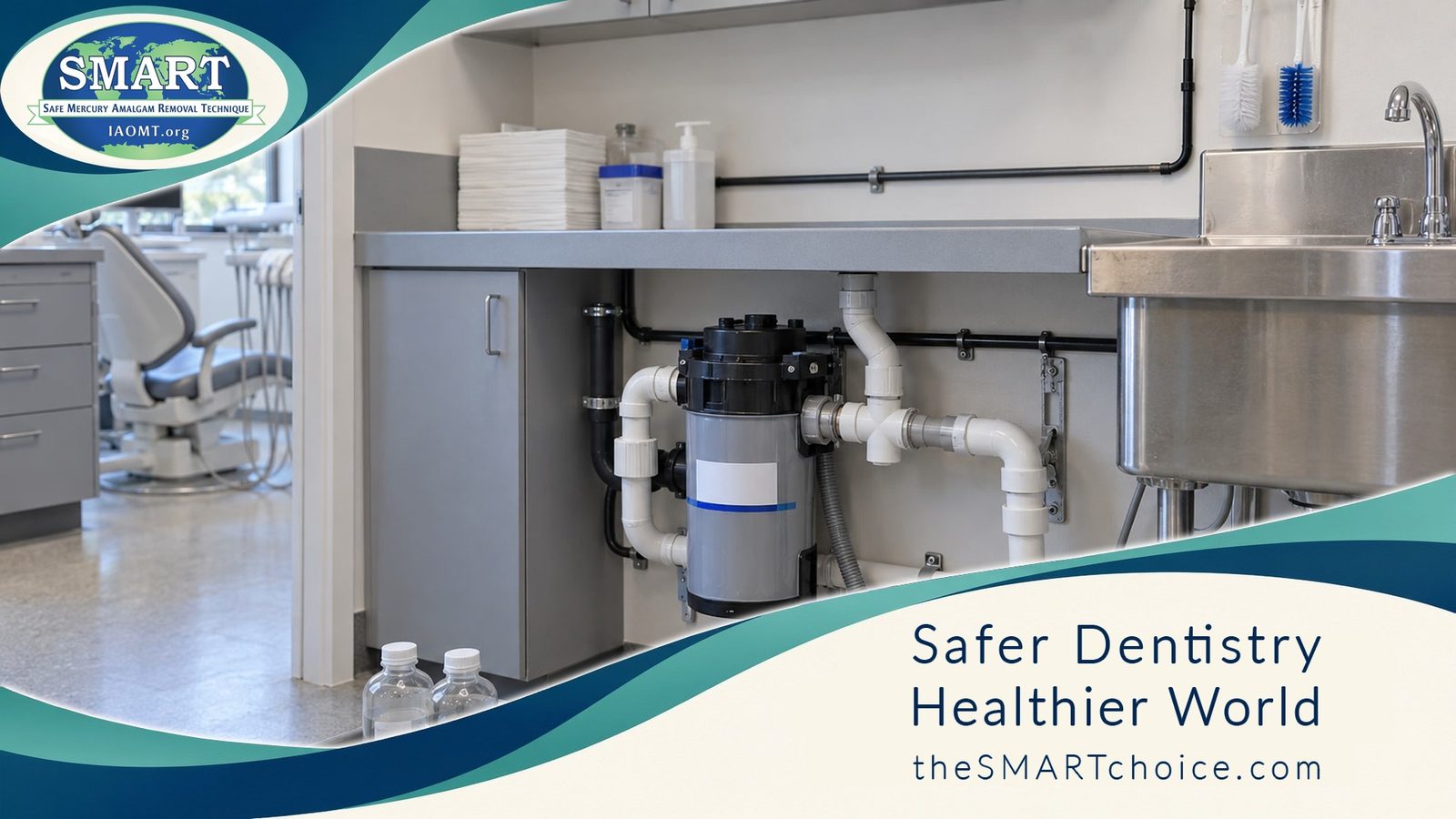
SMART removal keeps mercury out of lungs and soft tissues in the room; separators and waste best practices keep it out of rivers and sludge. Vandeven and McGinnis quantify why dental offices matter at the sewer plant gate (~6.5 tons/year to POTWs) even when final surface-water loads look smaller after treatment. That is exactly the environmental half of “Safer Dentistry, Healthier World”: chairside SMART plus capture-and-recycle hardware so amalgam debris never becomes someone else’s fish advisory.
Practical takeaways
- Removals dominate the wastewater load — Most internal discharge came from drilling out old fillings.
- Traps help but are not enough — Chair-side and vacuum filters still left tons heading to POTWs.
- Separators close the gap — Incremental capture beyond traps is the policy lever the paper models.
- Recycle captured amalgam — Separated waste belongs with hazardous-waste carriers, not the trash.
- Align clinic and community goals — SMART technique plus separators protect patients and watersheds.
Bottom line: Vandeven and McGinnis estimated ~35 tons of U.S. amalgam mercury use yearly, ~6.5 tons reaching POTWs after ordinary traps, and ~0.4 tons to surface waters via effluent and incineration pathways—underscoring why SMART practices and amalgam separators belong together.